Friday, April 12, 2013

Chris’ Dive Experiences: Travel......The Maldives & Mantas

Photo By: Damien Newton
Lesley and I have a routine before a trip starts and it goes something like this: pack gear, weigh it, take a few items out, reweigh it, repeat, repeat, repeat until we get our main bags to about 48 lbs. This is undoubtedly followed by a white knuckled (for Lesley) ride to a square piece of pavement near the airport which will be home to our car for a small fortune only to be followed by unloading, loading, and unloading again, bags and persons into an airport shuttle.  And then another white knuckled ride (this time for both of us) to the lovely...peaceful...slow paced sovereign nation known to all of us as LAX. It's no wonder why once you settle into your seat on the plane a collective sigh can be heard!

After settling in for your flight, you may start thinking about and anticipating certain types of diving that you will enjoy like drift dives, wreck dives, night dives or, if you're me, shark feed dives. Or you may be thinking of a certain species that this area is known for and what kind of dive experiences you may have with it. If you are a photographer or videographer you're definitely start anticipating certain dive sites with famous wrecks or reefs or the critters you expect to shoot on your dives. One thing is for sure if you're traveling to a place for the first time you just really don't know what that standout dive, encounter, or experience that you'll always remember will be.

Our trip to the Maldives was really no different. I expected to see the unbelievable beauty and feel the serenity that you get just by looking at pictures of the Maldives, mixed with an extremely healthy marine ecosystem with chances to see whale sharks, mantas and loads of fish.  What ended up standing out to me was something totally different.


Photo By: Lesley Alstrand

Prior to leaving for this trip, I arranged to take the PADI Manta Diver specialty course while sailing on our liveaboard. Little did I know at the time that I really couldn't have picked a better destination, or boat, anywhere in the world for this specialty. This would turn out to make my trip to the Maldives all about the manta.

After boarding the Sea Spirit, our home-away-from-home for this trip, we completed the usual paperwork and then listened to the briefing presented by our cruise directors and dive guides Matt and Anne-Marie Kitchen-Wheeler. During the briefing, among other things, it was announced that Lesley and I would be taking the Manta class and if anyone wanted to join the class, they were welcome to. Nobody at that point indicated much interest in joining us, so it looked like it would be just the two of us.

Photo By: Dr. Anne Marie Kitchen Wheeler


Fast forward through two full days of diving and it was time for our manta class orientation that evening. To our surprise, Lesley and I were joined by almost half the guests on board. Our cruise director, dive guide, and PADI manta class instructor was Dr. Anne-Marie Kitchen-Wheeler, who is also the project manager for The Manta Ecology Project in Maldives, and only the fourth person in the world to receive her PhD on mantas. In two days of diving, Anne-Marie's sharing of her knowledge and passion for mantas had obviously piqued the interest of the other guests on board and now they wanted to learn more. 


During our first manta class we learned about manta anatomy, feeding, cleaning, reproduction, conservation efforts, and proper techniques for diving with the mantas. Compared to other manta dives and conversations I had experienced with dive guides during previous trips to several different destinations, I was blown away by how much I learned during just the first class session with Anne. The species of mantas we were getting to dive
with in the Maldives were Manta Alfredi, also known as reef mantas, which is the species we also experienced while diving in Hawaii and Palau. Whereas in the Socorro Islands, we were diving with Manta Birostris, otherwise known as giant mantas.

Cleaning Reef Manta Photo By: Lesley Alstrand

After our first class session we where able to do a few dives with mantas and observe some of the the things we learned from Anne. The second class session a couple nights later was even better than the first. During this class we learned how to ID mantas. When identifying any animal, the more info you can gather, of course, the better, but key points to identifying a particular manta are sex, tail length, and spot patterns between the gills. This was another instance where I learned something new. You ID Reef Mantas using spot patterns located in between their gills. Whereas Giant Mantas are identified using the markings and patterns that are directly on and below their gills since the area between their gills will generally have no markings.


Swimming Giant Manta (Socorro Islands) Photo By: Lesley Alstrand

The next thing I learned totally blew my mind. Depending on how the manta holds its cephalic fins, you can tell what its planning to do next. For instance, you can tell if a manta is getting ready to feed, get cleaned, or swim off. I had noticed when diving with mantas in the past that different mantas had their cephalic fins in different positions and thought it was interesting, but I never knew it really meant anything.


Feeding Reef Manta Photo By: Dr. Anne Marie Kitchen Wheeler

There really isn't any other animal that I can think of where you can get an idea of what it is thinking of or about to do before they actually do it. Now, of course, you can see signs like possible aggression from a shark depending on their pectoral fin placement, but this can be hit or miss because they use these fins to swim and turn as well. Or maybe watching a lion hunt you obviously deduce that it is hungry and wants to eat, but this is different to me than the body language I was learning from the mantas.


Cleaning Reef Manta Photo By: Dr. Anne Marie Kitchen Wheeler

Seeing a manta swim toward the reef and relax it's cephalic fins way before it reaches the reef tells you it is thinking about getting cleaned which is exactly what I saw. That same manta, after getting cleaned for a few minutes, rolled it's cephalic fins up, telling us it was getting ready to swim and around 30 seconds latter it took off and didn't return. Most divers that see mantas see them while the mantas are feeding, so last but not least, a manta indicates it is time to feed by cupping its cephalic fins. This allows it to channel as much food as possible into it's mouth.

Swimming Reef Manta Photo By: Dr. Anne Marie Kitchen Wheeler

After absorbing all this new information, I was thrilled to test my knowledge, watch mantas, and use what I  had learned to ID them. Our next manta dive took place at night. We were split into two groups. Our instructor, Anne Marie, led the second group, while Lesley and I were assigned to the first group. My assigned task to pass the Manta Diver class was to take aqua paper (underwater paper) on our night dive and use it to record the sex and tail length of two mantas. In addition, I had to draw the spot markings of these mantas. This was a lot harder then I first thought it would be. Let's see, hold the pencil and clipboard underwater at night; shine your light at the manta swimming quickly overhead; set the light down on the clipboard and start drawing and recording info quickly. It took me about 30 minutes to get a small amount of info on each of these mantas. From the info I recorded on that first dive Anne was able to determine that two of the three mantas we had on our group's first dive were the same mantas she had on her group's second dive. All of this info was logged into the database where we learned we dove with a female manta named Wiggly and a male named Squiggly.

Photo By: Lesley Alstrand
The Maldives had the  healthiest reefs by far I have ever seen. The sheer amount of fish on these reefs was astounding. Mix that in with drift dives, wreck dives, the best night dive I've ever done, using reef hooks to watch dozens of grey sharks and white tips cruising by in current so strong we were all looking around to see what was making that loud noise we were hearing (which turned out to be nothing more than the water screaming past our ears), to secretly hand feeding some moray eels with scraps from our fish we were having for dinner that night (I WOULDN'T RECOMMEND IT but I had fun with it), and you might ask me what diving the Maldives is all about. For me, the Maldives will always be about the Manta!


For more information on mantas, check out Dr. Anne Marie Kitchen-Wheeler's
Manta Ecology Project Site 

Friday, March 29, 2013

Creature Feature: Flying Gurnard (Dactyloptena orientalis)

The first time I saw these guys was while critter diving in the Philippines. It was fascinating to watch them spread their wings and "take flight". I never got tired seeing them. I may have only spotted them in the Philippines, but the flying gurnard can be found from Hawaii to Japan, southward to central Polynesia, westward through Micronesia and Melanesia, through the East Indies, and across the Indian Ocean to the coast of Africa.  They prefer sandy bottoms and are generally found in shallow waters near the shore, but can be found at depths of up to 330 feet.

Flying Gurnards are classified in the scientific family Dactylopteridae, meaning "finger-fin". The word "gurnard" actually comes from an Old French word meaning "grunt". These fish get their name because of a special muscle in their bodies that pounds against their swim bladder when they are removed from the water, causing them to make a grunting sound. (Another common name for these fish is Sea Robin.)

These fish can actually grow up to 16 inches and are usually a grayish-brown color with dark markings and bright blue edges on their round pectoral fins. These pectoral fins are normally held tight to their bodies unless they feel threatened, then they expand their "wings" to increase their size and scare off predators. This also helps them to blend into their bottom surroundings.


As you know, flying gurnards don't actually fly. However, they can use their "wings" to help make short burst of "flight" through the water. To motor around, they generally use finger-like appendages on the front of their pelvic fins to walk on the ocean floor, hence their family classification. They search through the sand to munch on bony fish, crustaceans, and bi-valves.


These fish have been described as resembling frogs when you look at them from the side because of their large heads and eyes, and light-colored underbellies. Their body is covered in "armor" consisting of tough, prickly scales and two large hook-like spurs near the gills. So here's my question, how can these tough guys look so cute?

Friday, March 1, 2013

Chris’ Dive Experiences: And Now For Something Completely Different

One of the things Lesley and I were most anticipating when we were preparing for our recent trip to Mexico was a chance to dive in cenotes. Cenotes are openings to underground rivers with caves, rooms, and passage ways that form when an area of the roof over the underground river collapses.

Photo By: Lesley Alstrand
The cenote that I was most looking forward to diving was one called Angelita. This site is a sink hole with some very weird things going on which feel so surreal when diving it. After a drive out of town and a turn that lead us on a road through the jungle we pulled up to a dirt lot that had a wooden sign painted "Cenote Angilita". Part of the dive briefing included a walk to the dive site along a little trail cut through the jungle. During the walk the guide pointed out a oregano tree, gum tree, and lemon trees. The trail wound around to a flat rock that looked down over the sinkhole Angelita. After the site briefing we geared up to dive. We walked up to the same flat stone, held onto our fins, and did a 15 ft giant stride down into the water, grouped up and started our descent.

Photo By: Lesley Alstrand
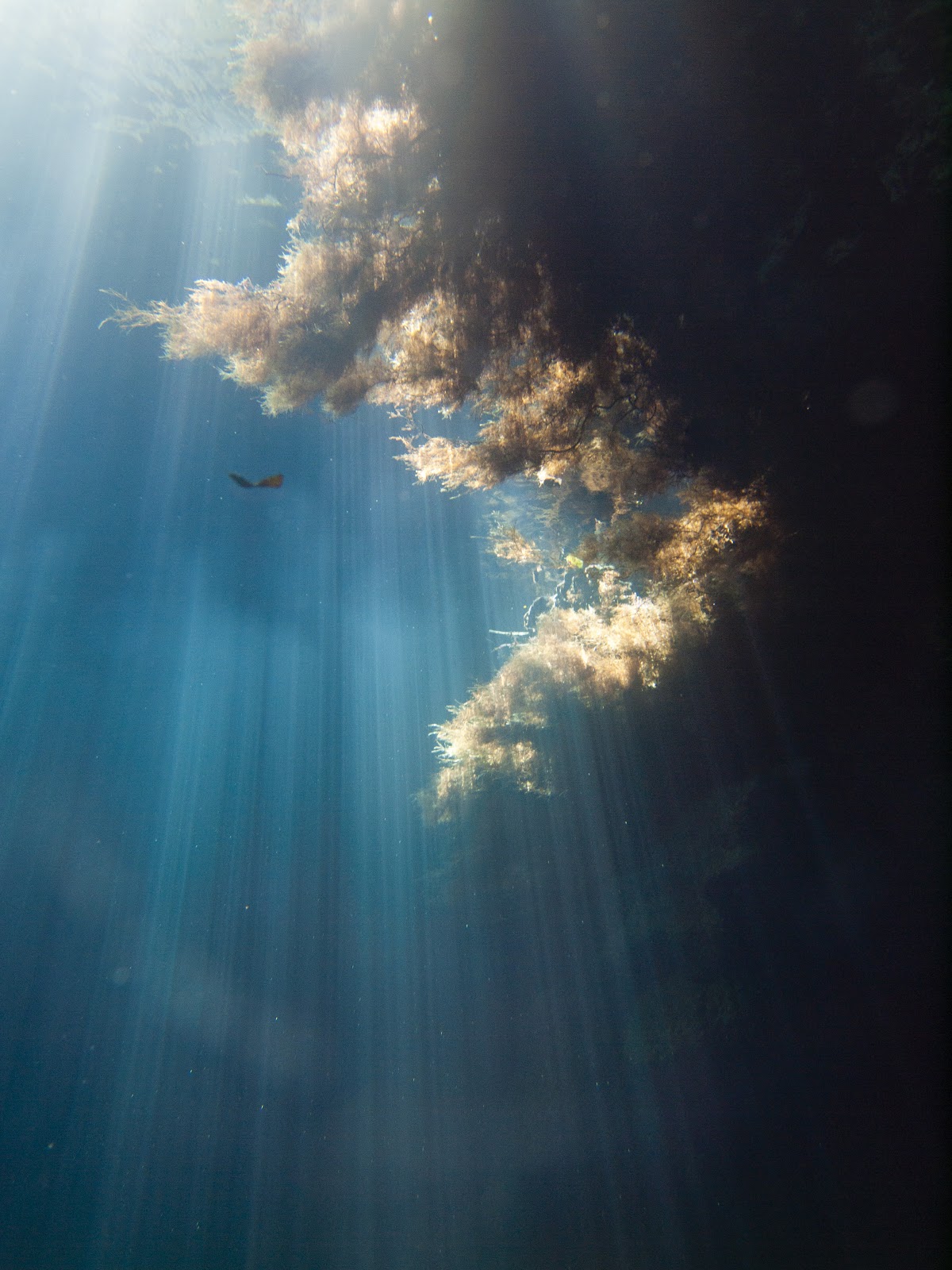
Looking down from the surface you had the same perspective as you do with blue water diving - the light rays dancing through the clear blue water. As we descended down you could look around 360 degrees and see that you where diving in huge limestone cylinder. 

Photo By: Lesley Alstrand

What looked like the bottom came into view soon after we started our descent.  There was a pile of rotting leaves and tree limbs surrounded by a reddish brown liquid.  It gave me the sense that I was floating in the air above a river with  a shore made of trees and a dirt area with tree limbs, not that I was 100 ft. underwater diving around broken tree limbs and piles of leaves.  The red-brown area is actually a hydrogen sulphide acid layer that looks like a flowing river. 


Photo By: Anatoly Beloshchin

Once we got our bearings our guide signaled us over to the safe area for us to descend through the acid layer. We grouped up in a circle holding on to each other and descended through a yellow rust color layer where the vis dropped to zero and the smell of rotten eggs drifted into your mask. Once we dropped about 3 feet through that layer the vis opened up to 50 feet plus, just quite a bite darker. Below us were tangled broken tree limbs that we swam over, around and through.   Because of the lack of oxygen in this acid layer, leaves that have been here for many weeks are just as green as they were when they first fell into the water. This was also an eerie experience because of the great viz mixed with the low light and swimming around a wasteland of broken trees and limbs.

Photo By: Lesley Alstrand

Since we were now at 115 ft our no-deco time started to run out so with 5 mins left we grouped back up holding each others hands and forming a circle and ascended back up through the layer. Once back above the layer we swam around the tree limbs and watched as other diver's bubbles came up through the layer we just ascended through. This made it look like heat from a fire rising since the bubbles were disrupting the layers of water and acid. As more divers came up from the bottom the water and acid layers began to mix making it look even more like a flowing river.

Photo By: Lesley Alstrand
Once our no-deco hit 5 mins at this shallower area we started our slow ascent around the edge of the sink hole. The sink hole is made up of limestone so the walls were very porous with shades of black and white running through out.

On the way up you could turn on your back and look up to see the edges of the sink hole with trees hanging over and clouds in the sky above them from a depth of 80 feet. At 30 feet we grouped up in a line and did a short swim through in the wall that turned slowly and came back out. We ended our dive with a long safety stop, surfaced and headed over to the rope to climb out of the sinkhole.

Photo By: Lesley Alstrand


This was by far the most unique dive I've ever done. If you're looking for a new place to dive or a new type of diving, give cenote diving a try in the Riviera Maya. This dive at Angelita was followed by a dive at Cenote Carwash which had stalactites hanging from  the ceiling and stalagmites rising from the floor and visibility was in the 100's of feet!

Friday, February 22, 2013

Creature Feature: Shame-Faced Crab


The shame-faced crab (aka box crab) gets its name from the way its claws (or chelae) cover its face as if it were trying to hide in shame.  Classified in the genus calappa, what distinguishes these crabs from others is their distinctly bulky carapace (upper portion of the shell) which can reach lengths up to 3.5 inches and widths of nearly 5 inches. The calappa species became labeled box crabs because when threatened these crabs pull their large pincers tight around their bodies, hiding their legs under the canopy of their carapace, forming a well-armored “box”.

The shame-faced crab’s squat, rounded and convex shell may be a rosy or yellowish hue with grooves and/or spots on it. The triangular mouth, as well as its eyes, are generally hidden behind the large forceps of its first pair of walking legs. In some species the impression of shame is further enhanced by large reddish-pink spots on the pincers which make the crab look even further embarrassed. The other pairs of legs are rather skinny since they are rarely used.

The shame-faced crab generally remains in an inactive state, burrowed in the sand, eyes looking upward, waiting for potential prey to come by. It can remain in this position for several days, with only its eyes, antennae and upper carapace protruding from the sand. Its forceps also protrude to form a “breathing cave” behind them, preventing sand from blocking its air passages. On the occasion that it does choose to run, it puts its body completely upright and straightens its legs. To bury its self again, it simply pushes its forceps against the sand like planks which then forces its body backward into its burrow.

This crab’s favorite snacks are oysters, mollusks, snails, and other marine invertebrates. Its specially formed forceps and right pincer are well-adapted to pick its prey apart, and strong enough to crack their shells. There is a large accessory tooth at the base of the moveable finger and a corresponding flat plate on the fixed finger which act like a vice to crack through the shell. The left pincer is relatively longer and sharper and used to extract the gastropod’s body from the broken shell. This guy below in the video doesn't accomplish his task with lightening speed, but watch  as he goes about getting some dinner.


http://www.waza.org/en/zoo/choose-a-species/invertebrates/other-aquatic-invertebrates/calappa-granulata

Friday, January 18, 2013

Chris’ Dive Experiences: Coral Diving In Southern California?

Thousands of Southern California scuba divers travel to Hawaii every year to
Photo Courtesy of Lesley Alstrand
dive on colorful coral reefs in clear water. A few of these divers no doubt know that there are beautiful purple hydrocoral- encrusted reefs teeming with fish right here in SoCal. When this site is caught on the right day, its visibility rivals Hawaii's.  The best part? It is just a short boat ride away.

Farnsworth Bank is a well known set of seamounts off the backside of Catalina Island, California. These seamounts are known for abundant marine life, purple hydrocoral, and great visibility. Farnsworth is equally known for ripping currents and zero visibility.  Due to these ever-changing conditions, getting to dive Farnsworth Bank is special. And catching it on a stellar day will give any diver a set of dives they will always remember.

Photo Courtesy of diver.net

Farnsworth Bank had been on my must dive list since I first got certified. I had been on two previous 3-day liveaboard trips that hit sites in the Southern Channel Islands and had intentions of diving the site, but conditions on both of those trips never allowed it. I awoke on the second day of my third trip to excitement from fellow divers. We were anchored at Farnsworth Bank. You couldn’t have asked for better surface conditions with no wind and the ocean laying as flat as a lake.

After a thorough dive site breifing, no one wasted time gearing up and jumping in. As we descended down the anchor line, we were greeted with equally good conditions underwater. Beautiful blue water with zero current and easily 80 feet of visibility. In these great conditions it took no time to see our target below us. As we looked down we could see a set of plant-encrusted seamounts surrounded with abundant fish life.

We dropped down to 100 feet and started working our way around and up the seamount, enjoying the contrast of the bright purple hydrocroal alongside the yellow and green of the kelp; the red, brown, and gold of the Gorgonians; all with a back drop of the cobalt blue of the Pacific Ocean. The life on these seamounts was supercharged from Seastars and Urchins to a variety of colorful Nudibranchs surrounded by Garibaldi, Rockfish, and Lingcod.


Photo Courtesy of Scott Gietler
The group slowly circled the pinnacle working their way up to shallower waters. At one point, as I was waiting for Lesley and Willey to finish up with pictures of a Rockfish, I backed off the site a touch into open water. This vantage point gave me a complete picture of what we were lucky enough to be diving on this exact day and time. I  looked down at the pair of photographers communicating with each other just a touch below me on a wall and I was speechless at the sight of the typical color palette of a southern California kelp dive mixed with some colors you may expect only to find off an island in the middle of the tropics. I looked up, taking in the sight of the sun dancing on the surface 65 feet above us pushing rays of sunlight through the water, when a flash out of the corner of my eye caught my attention. I turned to see a large Bat Ray swimming over the top of the seamount, with the sunlight bouncing off the tips of its pectoral fins as it swam. This vision solidified just how beautiful Southern California diving can be.

This dive will always be burned in my memory. The explosion of life and color that can be found right here in our backyard which yields experiences that would rival any tropical dive destination. Get out there and dive these special sites. It may take many times, but one day you'll be the one that was at the right place at the right time!

Photo Courtesy of Lesley Alstrand

Join The Dive Shack August 2-4 for a chance at diving Farnsworth Bank and other great sites around the southern Channel Islands.
http://www.gotodiveshack.com/pdf/SCIcharter.pdf

Friday, December 28, 2012

Creature Feature: Narwhal (Monodon monoceros)

While those of us in the Northern Hemisphere are now into the frigid winter season, what better topic to write about than that of a special, you might even say mythical, Arctic creature, the Narwhal. These unusual creatures are what legends are made of and the source of its horn has been the topic of a few tales.


The Inuit legend of the Narwhal
A wicked woman lived with her daughter and her son, who was born blind. As the son got older, his sight improved, even though the mother tried to convince him of his helpless state. One day a polar bear came near the house and the mother told the son to aim a bow and arrow at the bear through the window covered with seal skin and strike him down. The boy pulled back the arrow and the mother took aim from him. The arrow struck the heart of the bear and although the boy could hear the groans of the dying bear, the mother laughed scornfully at him, saying that he had missed the bear. That night the mother and the daughter had fresh polar bear meat while the mother cooked dog meat for the son. Later the boy's sister told her brother that his shot was successful and secretly gave him meat.

Time passed and an old man came to the house for a visit. Before he left, he told the young girl how she could help her brother regain his sight. In the spring, he told them to watch for a red-throated loon who would swim trustingly toward them. Once the loon was close enough, the blind brother should wrap his arms around the loon's neck and the loon would take him to the bottom of the lake. Once they came up, his sight would return. The loon told the young man not to tell about his regained sight until later in the summer when he would send a pod of belugas to their campsite.

When summer came and the ice began to break, the belugas began to move. On one occasion, a pod was closer to land than usual. The young man grabbed his harpoon and told his sister to accompany him to help him aim. They went to the shoreline and the mother, seeing the son with a harpoon, became concerned and followed them. Once she was close to them, the son gave the end of the line from the harpoon to his mother, asking her to tie it around her waist to hold the harpooned animal. The concerned mother told her daughter to make sure he was after a small animal as she was tied to the harpoon. The son instead aimed for the largest whale and harpooned him. The mother was cast into the sea. As she submerged she spiraled around the line, with her long hair twisting into a long lance. This is how the narwhal came to be.

In medieval times, Europeans believed the narwhal tusk was the horn from the legendary unicorn and it came with all the unicorn's magical powers. Believed to cure poisoning and melancholia, Vikings and other northern traders sold the horns for more than their weight in gold.


The name narwhal comes from the old Norse word "nar" which means corpse, referencing the blue-grayish, mottled pigmentation like that of a drowned sailor (calves are actually born brown, with no spots). The scientific name, Monodon monoceros, is a Greek derivative meaning "one-tooth one-horn" or "one-toothed unicorn". The narwhal, or narwhale as it is also known, is a medium-sized, toothed whale that lives year-round in the Canadian Arctic and Greenlandic waters, and whose closest relative is the beluga whale.

This fascinating horn is actually a very long tooth. All narwhals are born with 2 teeth in their upper jaw. After the first year of life, the male narwhal's left tooth grows outward in a counterclockwise spiral. The tooth can grow upwards of 7 to 10 feet long. The function of the tooth is not exactly known. It has been suggested it might be used as a display of dominance during rivalry or courtship, it may aid in obtaining food, or even be used to amplify sonar pulses emitted by the narwhal, but it has not been shown to be used as a weapon. "Tusking" is a behavior displayed by males when they rub their tusks against one another, possibly to determine dominance within the group.

Narwhals travel in pods of 4 (keeping to generally smaller groups under the winter ice cap)  up to 20 in the summer, feeding on fish, shrimp and squid. In winter, they eat benthic critters (flat fish) as deep as 4900 ft (1500 m) under the arctic ice. They are the deepest diving mammals. Their dives can last anywhere from 7 to 25 minutes. Sometimes these groups fall victim to the shifting ice pack, get trapped and are hunted by Inuit, polar bears, orcas, or walruses. In the summer they congregate in larger groups, in shallower ice-free waters.


Narwhals are very vocal creatures, making clicks, squeals and whistles to communicate and/or navigate.


Paul Nicklen/National Geographic/Getty Images
Fast Facts
Type:  Mammal
Diet:  Carnivore
Size:  13 to 20 ft
         (4 to 6.1m)
Weight:  3,500 lbs 
             (1,600 kg)
At Birth: 5 ft; 175 lbs
Max Life Span:  50 yrs


[1] http://en.wikipedia.org/wiki/Narwhal
[2] http://www.enchantedlearning.com/subjects/whales/species/Narwhal.shtml
[3] http://animals.nationalgeographic.com/animals/mammals/narwhal/
[4] http://www.narwhal.org/IntuitLegend.html

Friday, December 7, 2012

Be a Hero with a "Save-A-Dive Kit"

Ever been all set to go for a dive and at the last minute your buddy realizes he’s forgotten something, or worse, some piece of your equipment has broken, and you had to call the dive? Wasn’t that just the worst? Or even worse, what if this happened to you on your trip-of-a-lifetime in that exotic destination you had always dreamed of diving?

Recently, on a SoCal live-aboard trip I led for a weekend of diving, we had many different equipment issues pop up that could have ended diving for several people on board.  If it were a local beach dive, that might not have been such a big deal, but being stuck sitting on the boat all weekend while everyone else is diving really isn’t all that much fun. And for me, it is not an option at all.

When I pay to go on a trip to get several dives in (especially in a new location), I want to make sure I am prepared for any unexpected events, such as gear malfunctions.  So I would like to talk a bit about some of those unexpected events and what you, as a well-prepared diver, can do to save the dive.

We all know scuba is a pretty gear intensive sport, so there could be a number of things that might go wrong that you can be prepared for.  Let’s start with some of the easy fixes with basic equipment: masks, fins, mouthpieces, snorkels and streamlining clips.  Having a spare strap or two for masks and fins is always a great idea.  Extra snorkel keepers are also a good thing to have around, as well as spare gear clips for streamlining (including retractors).  For those divers who have a tendency to bite down harder on their mouthpiece than they need to, having an extra one for yourself or a dive buddy can come in handy.  It’s always nice to make sure everyone has their equipment streamlined.  Spare clips for your’s or your buddy’s hoses are an easy thing to carry extra of.  Remember it might be you that has to use your buddy’s octo.  Do you really want it dragging around in the sand because he forgot his clip?  Another simple piece of gear that is great to have on hand is a box of spare o-rings.


Now let’s move on to something that takes a little bit more thought: BCD’s and dive computers.  Even though we take care of our gear, once in a great while something is bound to break.  The bcd has many areas of concern, such as buckles, straps and weight pouches.  Of those, the one that poses the most common problem is the weight pouches.  They generally do not break, but they do fall out on occasion for different reasons.  If you lose one, there is no safe way to do the dive without proper weighting.  Having a spare pouch (or if you’re “old school”, a spare weight belt) or two will come in handy.  And if you have changed out your original bcd tank strap for maybe a quick release type, you might just want to keep the old one in your dive bag just in case.

Now to what I think is the biggest issue that might end your dive: the dive computer.  Atomic and Suunto make great computers, but remember they are just that, an electronic device.  The main reason any computer might fail is often the battery.  Make sure you check the battery status before you go on your dive, and always have a replacement battery available.  If you can’t replace the battery yourself, you might have a tech nearby that knows how to do it for you.  And while I am on the subject of batteries, make sure you have a spare one for the transmitter to your air-integrated computer.  Another great idea is to have a completely separate computer.  Yes, you should be diving with two computers on your body, just in case.  If one of your computers fails during your dive, you are still able to continue on because you you’re your backup computer.  I really don’t know too many professional divers who dive with just one dive computer.  It just makes sense to have redundancy when it comes to such important equipment. 

So to make sure you have a worry free dive, you should carry with you what we call a “Save-A-Dive Kit”.  This will help to make sure you, or your buddy, can still make the dive no matter where you are, beach or boat.  Unfortunately, we cannot fix everything in the field, but for 99 percent of the issues that may come up, we can.  It doesn't have to be anything fancy. Just make sure your kit has the spare items that will keep you from calling your dive.  If you have any questions about what to put into your kit, talk to your instructor or go to your local dive shop.  If you are one of those people who don’t think it is necessary to have a kit, I have a question for you.  Why do we carry a spare tire in our vehicles?  How often does a tire go out on us?  Better safe than sorry – right?  One last thing, the kit does not have to be just for your dive gear.  Don’t forget about your underwater camera.